Why Good P6 Students Struggle in Sec 1 (and What Most Parents Miss)

By Desmond, Founder · Updated · 6 min read
Every year, we meet parents who are caught off guard in Term 1. Their child did well at the PSLE, sometimes very well. Then the first Sec 1 test comes back, and the marks have dropped. The question is always the same: “My child was always good at Math. What happened?”
It’s rarely about ability. In our experience, the habits that worked best in P6 are often the ones that hold students back in Sec 1. That’s why good students are the most surprised.
The problem nobody warns you about: PSLE habits
P6 is built around one exam. Revision is planned for students, practice is heavily drilled, and many parents manage the timetable. That works well for the PSLE.
Sec 1 asks for different things. Students need to understand ideas rather than recognise question types, explain rather than recall keywords, and manage their own work across many more subjects. A student who has never had to do these things is not weak. They just haven’t practised them yet.
Here are the five jumps we see most often.
1. Math: model drawing stops being enough
In primary school, strong students get very good at model drawing and heuristics. P6 introduces simple algebra, but most PSLE questions can still be solved without it.
In Sec 1, algebra becomes the main tool. Students meet negative numbers, expand and simplify expressions, solve equations, and turn word problems into equations. Here is the same question solved both ways.
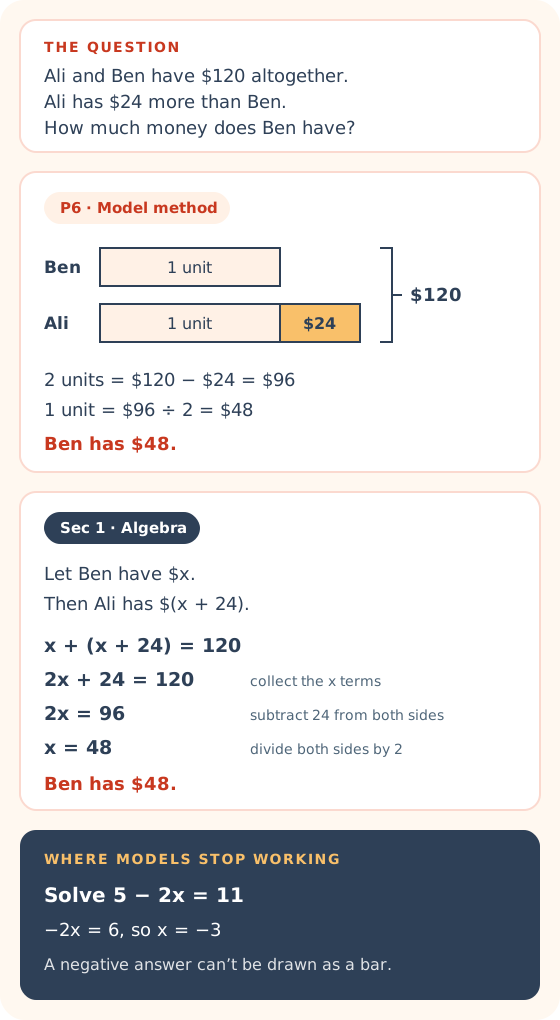
Students who keep reaching for models in Sec 1 run into three problems:
- They are slower, because they draw a model first and only then translate it.
- Models can’t handle negative numbers or longer equations, which arrive within the first few months.
- They lose method marks, because teachers expect each step of the working to be shown as an equation.
What helps: practise writing “Let x be…” for simple word problems, get comfortable with negative numbers early, and show every step, even when the answer seems obvious.
2. Science: from “what happens” to “why it happens”
PSLE Science rewards precise keywords. Sec 1 Science goes a level deeper. Students learn that everything is made of tiny particles, and they are expected to use that idea to explain what they see.
Take a simple question: why does a balloon get bigger when it is heated?
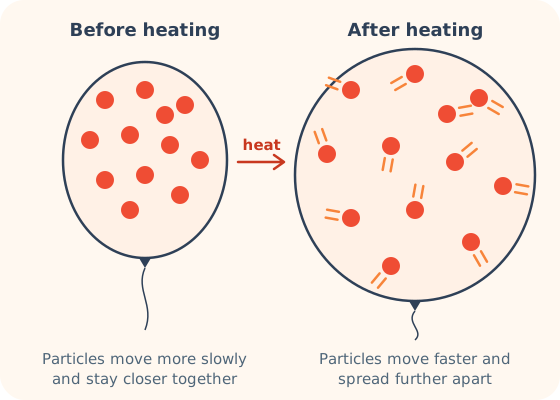
A typical P6 answer: “The air inside the balloon gains heat and expands.”
A Sec 1 answer goes further: “When the air is heated, its particles gain energy and move faster. They spread further apart, so the air takes up more space and the balloon gets bigger.”
Sec 1 Science also brings more measurement and calculation, with units, formulas and data from experiments. Memorised keywords don’t carry over well. Understanding does.
3. More subjects, and nobody chasing
| P6 | Sec 1 | |
|---|---|---|
| Subjects with tests | English, Mother Tongue, Math and Science | These four, plus subjects such as History, Geography and Literature |
| Teachers | A few teachers who know the class well | A different teacher for most subjects |
| Assessments | Built around one big exam, the PSLE | Weighted assessments through the year, plus an end-of-year exam |
| Math | Models and heuristics | Algebra and equations |
| Science | Describe what happens, using keywords | Explain why, using particles, units and data |
| After school | Mostly home and revision | CCA, longer days, more independence |
| Homework | Often checked and chased by teachers and parents | More work set online, with deadlines to track |
Subjects and arrangements vary by school, but the pattern is the same: more subjects, more teachers, and much less hand-holding. Students who relied on someone else to plan their revision now have to do it themselves, often for the first time.
4. The confidence shock
Sec 1 classmates often have similar PSLE scores. A student who was near the top of their P6 class may now be in the middle. That’s completely normal, but it can feel like failing.
Add a lower first test mark, and some students quietly decide they are “not good at Math”. That belief is far harder to fix than any topic. How parents react to the first dip matters more than the dip itself.
5. The long holiday
After the PSLE, there are about two months before Sec 1 starts. Rest is well deserved. But many students do no Math at all for that whole time, and arrive in January rusty, just as new topics start coming quickly.
We’re not saying cancel the holiday. A short, light routine in the second half of it makes a real difference.
Why Sec 1 matters more than you think
Under Full Subject-Based Banding, your child’s PSLE results set the starting level for each subject, at G1, G2 or G3. That level can change. Sec 1 and Sec 2 results then decide much of what comes next, including whether options such as A Math and Pure sciences are open in Sec 3. Our guide to G2 vs G3 Math explains the levels.
In other words, the PSLE is a starting point, not the finish line. Gaps that open in Sec 1 tend to widen in Sec 2.
What parents can do in the post-PSLE holidays
- Let them rest first. A few weeks off after the PSLE is healthy.
- Then start a light routine. Two or three short Math sessions a week in December is enough to stay sharp.
- Preview, don’t drill. Negative numbers and simple algebra, such as using letters for unknowns and solving simple equations, are the most useful topics to look at early.
- Ask “why” questions. When your child explains something in Science, ask why it happens. It builds the habit Sec 1 Science needs.
- Set up a planner before school starts, so tracking homework and test dates is a habit from day one.
- Expect a dip, and plan your reaction. When the first test comes back, look at where marks were lost, not just the score.
- Act early. If a topic still hasn’t clicked by the middle of Term 1, get help then. It’s much harder to catch up in Term 3.
A head start, not a race
None of this means P6 students should spend the holidays studying Sec 1 work all day. The aim is simpler: start Sec 1 with the basics fresh, and with a clear idea of what’s different.
Our Headstart 2027 holiday classes for students starting Sec 1 cover Term 1 Math and Science topics in December, so the first weeks of school feel like revision instead of catching up. And if you’d like to know where your child stands, our free diagnostic assessment shows which topics are strong and which need work.